

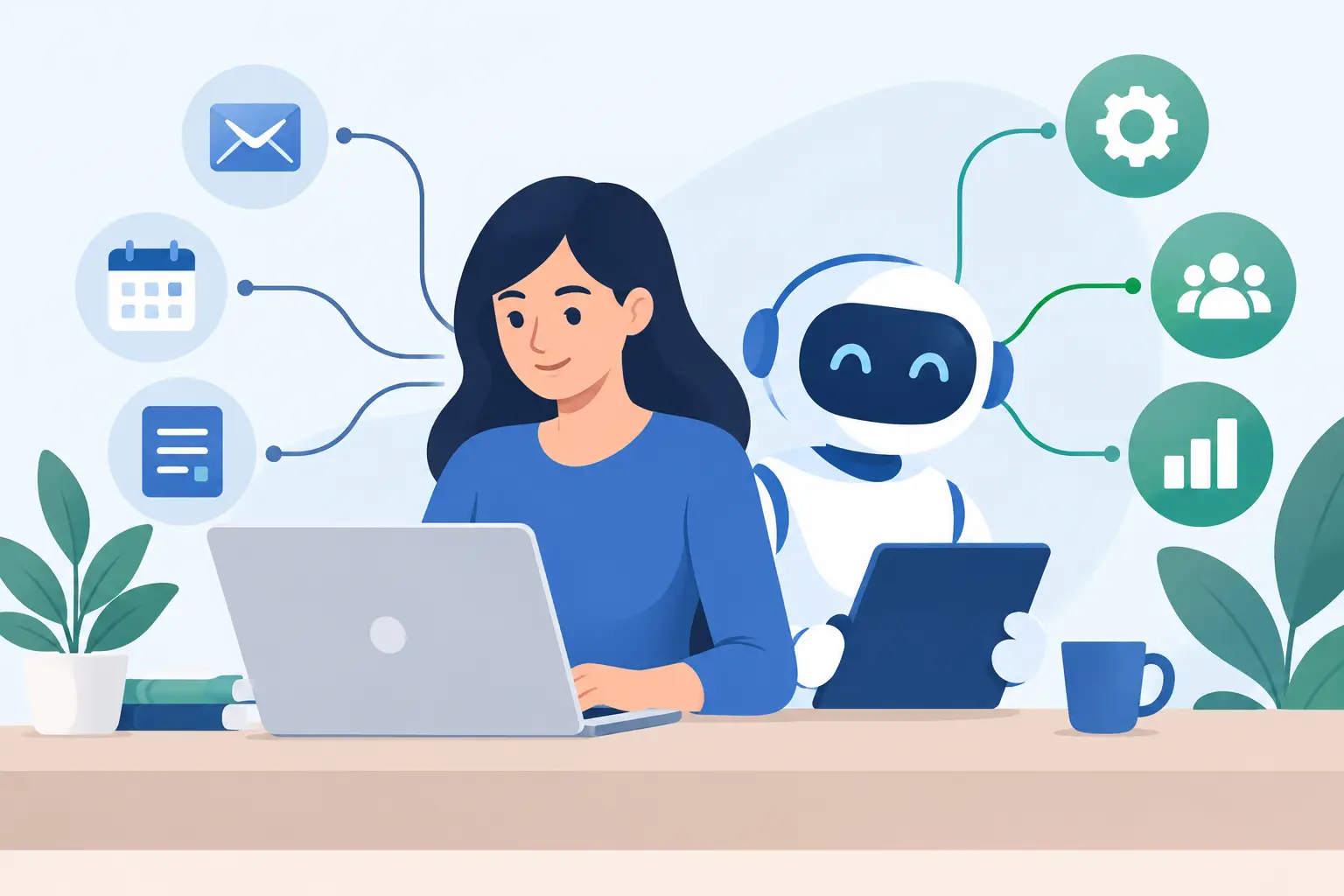
A growing backlog rarely means a business needs more software. It usually means capable people are spending too much time on repeatable work: preparing reports, updating records, responding to routine inquiries, organizing leads, and chasing follow-ups. An AI skilled virtual assistant gives your team a dedicated remote professional who can handle that work faster while applying judgment, brand context, and accountability that automation alone cannot provide.
The goal is not to replace your team with AI. It is to give your business a dependable coworker who knows how to use AI tools responsibly, follows your processes, and turns scattered administrative effort into consistent operational support.
What an AI Skilled Virtual Assistant Actually Does
An AI skilled virtual assistant is a trained remote professional who combines core business skills with practical fluency in AI-enabled tools. Depending on the role, they may use approved platforms to draft first-pass content, summarize meetings, categorize customer requests, research prospects, clean data, create process documentation, or speed up routine reporting.
The distinction matters. A generic AI tool can generate an answer, but it does not understand your priorities, recognize exceptions, ask a clarifying question, or take ownership of the next step. A dedicated assistant can. They review outputs, apply your voice and standards, escalate sensitive issues, and improve the workflow over time.
For a busy operations leader, this can mean fewer hours spent moving information between systems. For a founder, it can mean arriving at the day with organized priorities rather than an inbox full of unfinished decisions. For customer-facing teams, it can mean faster first responses without sacrificing the care that keeps clients loyal.
Where AI-Enabled Support Creates the Most Value
The strongest use cases are recurring processes with clear inputs, a repeatable standard, and a real cost when they are delayed. Administrative and executive support are natural starting points. An assistant can organize calendars, prepare meeting briefs, capture action items, maintain task boards, and use AI to create usable first drafts of internal documents.
Customer service teams can benefit when assistants sort incoming requests, identify common questions, prepare response drafts from approved knowledge, update CRM records, and flag urgent or unusual cases for a manager. The assistant remains responsible for judgment and quality control. AI simply shortens the time required to complete the first layer of work.
Sales and marketing workflows also offer practical opportunities. A skilled virtual assistant can research accounts, enrich lead lists, prepare prospecting notes, repurpose approved content for social channels, monitor campaign data, and keep follow-up tasks current. In bookkeeping and accounting support, AI can help organize source documents and summarize patterns, while the assistant follows your procedures and routes decisions that require qualified financial review.
The right assignment depends on the role and the risk level. High-volume, low-risk work with documented rules is usually the best place to begin. Confidential decisions, regulated advice, final legal or financial approvals, and sensitive client communications should stay under appropriate human oversight.
AI Skilled Virtual Assistant or Automation Alone?
Automation is valuable when a process is stable and predictable. If every form submission should create the same record, notify the same person, and trigger the same sequence, a workflow tool may be the right answer. It is fast, consistent, and does not need daily direction.
But many business processes are not that clean. A prospect may use vague language. A customer may be frustrated but not explicitly ask for escalation. A report may show a number that looks wrong because of a system change. These moments require context.
An AI skilled virtual assistant bridges the gap between automation and full-time domestic hiring. They can operate the tools, spot exceptions, communicate with stakeholders, and refine the process when the business changes. They also give you a single accountable owner for work that would otherwise be spread across several employees.
That does not mean every task needs a person. The most efficient model often combines both: automate predictable handoffs, then assign a dedicated assistant to manage exceptions, quality, communication, and continuous improvement.
How to Delegate Without Creating More Work
Businesses sometimes hesitate to hire remote support because they fear the training burden. That concern is reasonable. Delegation fails when an owner hands off a vague responsibility, expects instant mind-reading, and has no method for reviewing results.
Start with one function that is important but repeatedly pulls experienced employees away from higher-value work. Define the outcome, not just the activity. Instead of assigning “manage the inbox,” explain which messages should receive a same-day reply, what information must be captured, what can be answered using templates, and when the assistant should escalate.
Your first week should establish access, examples, priorities, and communication norms. Provide successful past work, standard operating procedures, brand guidelines, and a short list of common exceptions. A capable assistant can help document the process, but they need an accurate starting point.
During the first month, review work more frequently than you expect to long term. Look for accuracy, response time, judgment, and consistency. Give specific feedback tied to examples. “Use a warmer tone with existing clients” is less useful than showing two approved responses and explaining why they work.
Once the work is stable, shift from checking every task to tracking a few meaningful outcomes. Those may include turnaround time, completed follow-ups, ticket resolution quality, data accuracy, campaign output, or the number of leadership hours returned each week.
What to Look for When Hiring
AI familiarity is useful, but it should not be the only hiring criterion. A candidate who can name every new tool but cannot protect confidential information, follow instructions, or communicate clearly will create more risk than value.
Look for a combination of role-specific experience, strong written and verbal English, comfort with your core systems, and an ability to explain how they validate AI-generated work. Ask candidates to describe a process they improved, not just the tools they have used. Their answer should show that they understand the difference between producing output and delivering a reliable business result.
You should also ask how they handle uncertainty. The best answer is not “I will use AI to figure it out.” It is “I will check the approved resources, identify what is missing, and ask the right question before moving forward.” That mindset protects quality and prevents costly assumptions.
For US companies hiring offshore, the staffing model matters as much as the individual candidate. A managed provider can reduce the administrative load by sourcing qualified professionals, screening for skills and cultural fit, coordinating interviews, supporting onboarding, handling HR and payroll, and providing visibility into verified work time. This structure lets you retain control over who joins your team and how they work while avoiding the complexity of managing international recruitment alone.
Build Guardrails Before You Scale
AI increases speed, which makes clear boundaries more important. Before assigning AI-assisted work, decide which tools are approved, what data can be entered into them, who can access customer or financial information, and which outputs require human approval before they are shared externally.
Create a simple review process for sensitive work. For example, an assistant may prepare a client email, but a manager approves strategic messages until the assistant has demonstrated consistent judgment. They may summarize financial data, but a qualified team member reviews any conclusions. They may build a knowledge base draft, but your subject-matter expert confirms accuracy.
These controls are not a sign of distrust. They are how mature teams make delegation safe enough to grow. The same principle applies to access management, password policies, documented procedures, and time tracking. Transparency protects both the business and the remote teammate.
Turn Extra Capacity Into Better Operations
The biggest return from an AI-capable assistant is not simply faster task completion. It is the operational space created for your internal team. When routine work has a clear owner, leaders can spend more time on clients, revenue, hiring, product decisions, and process improvements that cannot be delegated as easily.
Virtual Coworker helps businesses build that capacity with dedicated, AI-skilled professionals in the Philippines who are selected for the role, supported through onboarding, and positioned to work as long-term members of the team. The right assistant does more than clear a task list. With clear expectations and the right safeguards, they become the person who helps your business keep moving when demand increases.