
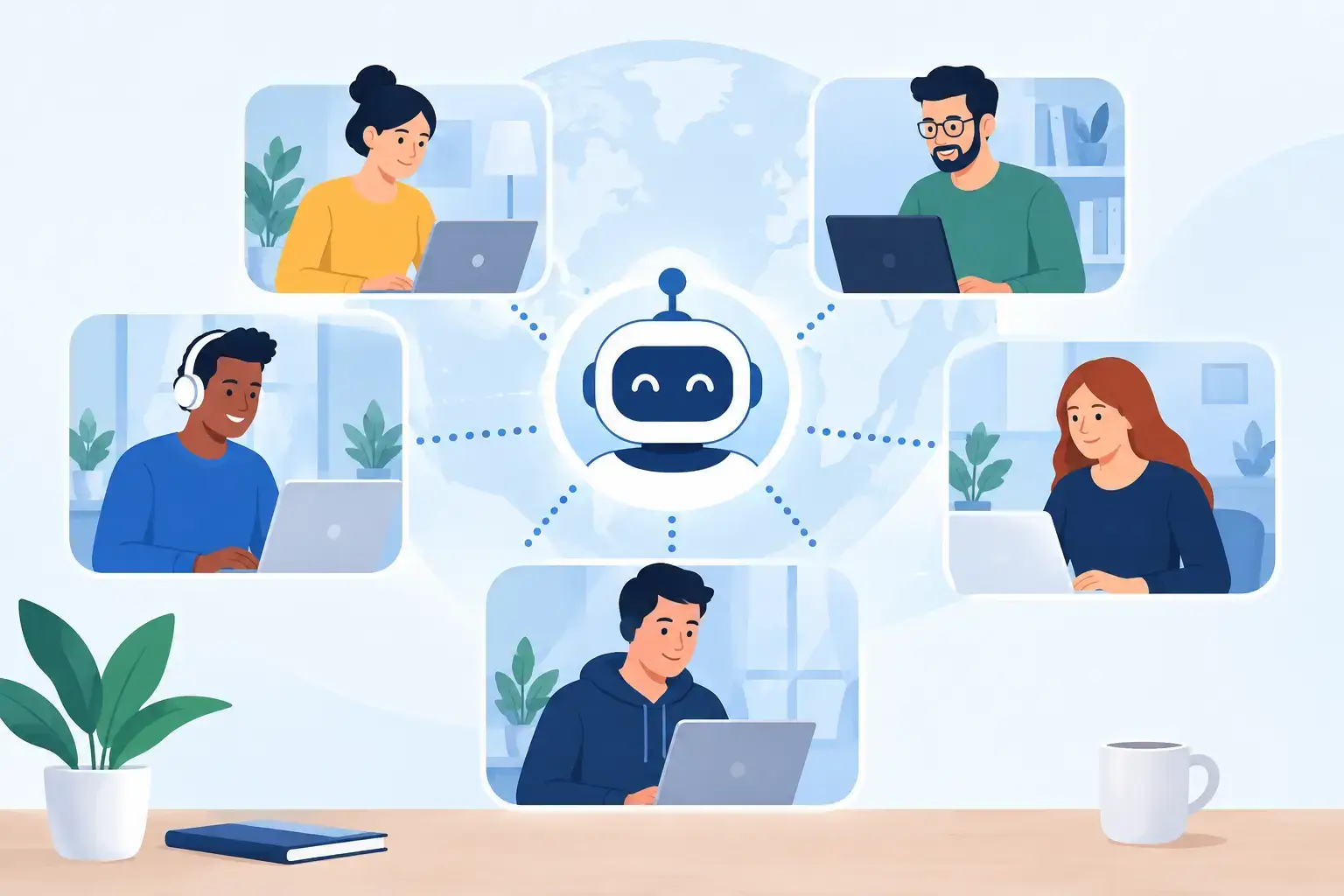
A growing business rarely has a labor problem alone. It has a capacity problem: customer requests are waiting, follow-ups slip, reports take too long, and skilled employees spend too much time on repetitive work. AI staffing gives businesses a practical way to address that pressure by pairing capable remote professionals with the right AI tools and operating systems.
The goal is not to replace people with software or hire a team that works without direction. The strongest model combines human judgment, accountability, and communication with technology that speeds up research, drafting, organization, analysis, and routine workflows. Done well, it gives leaders more time for revenue, client relationships, and decisions that require experience.
What AI Staffing Means for Your Business
AI staffing is the practice of hiring team members who can use artificial intelligence responsibly as part of their day-to-day role. An AI-skilled virtual assistant, marketer, customer support representative, recruiter, or operations specialist does not simply submit prompts and forward the results. They use AI to improve the speed and consistency of their work, then apply human review before work reaches a customer, prospect, executive, or internal system.
For example, an executive assistant may use approved tools to organize meeting notes, create a first draft of follow-up emails, and prepare a weekly priorities summary. A customer service representative might categorize incoming tickets, surface relevant knowledge-base information, and draft replies for review. A marketing assistant can repurpose a long-form asset into social copy while protecting the brand voice and checking every claim.
The distinction matters. AI can accelerate a process, but it cannot own the outcome. Your dedicated teammate remains responsible for understanding the assignment, following your standards, protecting sensitive information, and knowing when a decision needs to come back to you.
Why AI-Skilled Remote Talent Delivers More Capacity
Most businesses do not need to redesign every process before they see value from AI. They need dependable people who can identify repetitive steps inside existing work, use the appropriate tools, and keep the process moving. That is where dedicated remote staffing has an advantage over task-based freelance arrangements.
A dedicated teammate learns your customers, systems, preferences, and definitions of quality over time. Instead of repeatedly explaining how you want leads qualified or reports formatted, you build a working rhythm with someone who understands the context. AI then helps that person complete the repeatable portions of the work faster.
This can create meaningful leverage across departments. In operations, AI-skilled staff can clean data, document processes, prepare status updates, and maintain internal knowledge. In sales, they can research accounts, update CRM records, draft follow-ups, and organize pipeline activity. In finance, they can assist with invoice processing, transaction categorization, and report preparation under appropriate controls.
The value is not measured by how many AI tools a team uses. It is measured by whether turnaround time improves, errors decrease, leaders regain focus time, and customers receive a better experience.
Start With Work, Not Software
The wrong way to approach AI staffing is to choose a tool first and then search for something to automate. That often produces scattered experiments, inconsistent output, and frustrated employees. Start with the work that is already consuming time.
Look for tasks that are frequent, rules-based, and easy to review. Examples include inbox triage, calendar coordination, data entry, call summaries, social scheduling, basic lead research, candidate sourcing, customer ticket categorization, and recurring report preparation. These tasks still need human ownership, but many of their steps can be accelerated with AI.
Then separate the work into three levels. The first is low-risk administrative work where an assistant can use approved tools with standard quality checks. The second involves customer-facing or brand-sensitive work that requires closer review and clear templates. The third includes financial, legal, medical, confidential, or high-stakes decisions where AI output should be tightly restricted or avoided altogether.
This approach protects quality while helping you decide what kind of professional to hire. A business that needs executive support and workflow coordination needs a different profile than one that needs customer support coverage or digital marketing production. Define the outcomes first, then identify the AI skills that will help the person achieve them.
The Human Controls That Make AI Staffing Reliable
Speed without oversight can create expensive mistakes. AI may produce a polished response that is inaccurate, outdated, too generic, or inconsistent with your policies. That is why successful AI staffing requires operating standards, not just access to a subscription.
Your team should know which tools are approved, what data can be entered, and what information must never leave your protected systems. Customer records, financial information, proprietary documents, passwords, and sensitive personnel data all require clear handling rules. If a task involves confidential material, use a process designed for that level of risk rather than assuming every AI platform offers the same protections.
Quality control should also be built into the workflow. Early on, ask the teammate to submit drafts, summaries, or proposed actions for review. Provide examples of strong work and explain what needs adjustment. As trust and accuracy grow, you can expand the areas they own independently.
This does not need to create more management. A short standard operating procedure, a shared set of examples, and a weekly check-in often prevent the confusion that creates rework later. The best systems make expectations visible: what good looks like, who approves exceptions, and how work is tracked.
Hiring for AI Fluency and Operational Judgment
A candidate should not be selected solely because they can name popular AI platforms. Tools change quickly. The more durable qualification is the ability to think critically, follow a process, communicate clearly, and recognize when an output needs verification.
During interviews, ask candidates to explain how they would use AI in a real scenario from your business. If you manage an eCommerce brand, ask how they would handle a product-question backlog while ensuring answers remain accurate. If you run a professional-services firm, ask how they would turn meeting notes into a client-ready follow-up without exposing confidential information.
Strong candidates will describe both efficiency and safeguards. They will discuss checking source information, preserving tone, flagging uncertainty, and escalating exceptions. They understand that AI output is a starting point, not a finished deliverable.
Communication skills remain essential. Your remote teammate should be comfortable asking clarifying questions, documenting decisions, and working during the hours that support your team. The technology may make work faster, but dependable collaboration is what makes the role sustainable.
Build the Role Around Measurable Outcomes
AI staffing works best when the role has clear ownership. Avoid assigning a vague instruction such as “use AI to make us more efficient.” Give the teammate a defined lane and a set of outcomes that matter to the business.
For an operations assistant, that may mean reducing the time required to prepare a weekly report, keeping project records current, and documenting repeatable processes. For a customer support professional, it could mean maintaining response-time targets, improving ticket categorization, and escalating priority issues correctly. For a marketing assistant, it may mean delivering a consistent content calendar, repurposing approved assets, and keeping campaign reporting organized.
Track a small number of practical metrics during the first 30, 60, and 90 days. Consider turnaround time, revision rate, response time, completed task volume, backlog reduction, and manager hours saved. Numbers show where the workflow is improving and where more training or guardrails are needed.
A managed staffing partner can reduce the administrative burden behind this process. Virtual Coworker helps businesses source, screen, and onboard dedicated AI-skilled professionals in the Philippines while supporting payroll, HR, and verified work-time visibility. That structure allows leaders to focus on selecting the right person and building a productive working relationship.
Where AI Staffing Can Fall Short
AI staffing is not a shortcut for unclear leadership or broken processes. If no one knows who owns a task, what a successful outcome looks like, or which information is current, adding AI will often magnify the confusion. A capable remote teammate can help document and improve a process, but they still need access, direction, and reasonable decision boundaries.
It also depends on the role. A high-volume administrative workflow may see immediate gains, while a complex relationship-driven role may benefit more gradually. Some work should remain entirely human-led, especially when it requires nuanced judgment, sensitive conversations, or final approval on material business decisions.
The practical opportunity is to give good people better leverage. Start with one role, one workflow, and one measurable business result. As your teammate learns the business and earns trust, you can expand their ownership with confidence. The result is not a faceless automation layer, but a dependable coworker who helps your team move faster without losing the judgment that makes your business valuable.